
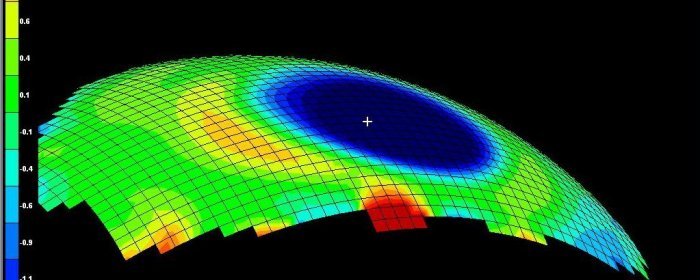
This US study compared 28 short-sighted children aged 8 to 11 who had undergone Overnight Vision Correction (OVC) treatment and subsequently worn overnight ortho-k corrective contact lenses for two years against an equivalent group wearing conventional soft contact lenses. After two years, the results for children wearing OVC lenses showed that their eye elongation – which determines focusing – had increased modestly and was almost 60% less than that experienced by children who had been wearing conventional soft lenses thus indicating that OVC had slowed down the further progression of short-sight.
Methods: Forty subjects were fitted with corneal reshaping contact lenses. All subjects were 8 to 11 years and had between -0.75 D and -4.00 D myopia with less than 1.00 D astigmatism. Subjects were age-matched to a soft contact lens wearer from another myopia control study. A-scan ultrasound was performed at baseline and annually for 2 years.
Results: Twenty-eight of 40 (70%) subjects wore corneal reshaping contact lenses for 2 years. The refractive error and axial length were similar between the two groups at baseline. The corneal reshaping group had an annual rate of change in axial lengths that was significantly less than the soft contact lens wearers (mean difference in annual change = 0.16 mm, p = 0.0004). Vitreous chamber depth experienced similar changes (mean difference in annual change = 0.10 mm, p = 0.006).
Conclusion: Results confirm previous reports of slowed eye growth following corneal reshaping contact lens wear.
June 2009 British Journal of Opthalmology. J J Walline, OD, PhD, FAAO, L A Jones, L T Sinnott
For full article go to: British Journal of Ophthalmology
